
Microchip TC648BEOA Fan Speed Controller: Features and Application Circuit Design
The Microchip TC648BEOA is a versatile and highly integrated fan speed controller designed for efficient thermal management in electronic systems. It operates by sensing the temperature through an external NTC thermistor and dynamically adjusting the speed of a cooling fan to maintain optimal thermal conditions. This not only ensures effective cooling when necessary but also significantly reduces power consumption and acoustic noise by operating the fan at lower speeds during cooler conditions.
Key Features of the TC648BEOA
A primary advantage of the TC648BEOA is its fully integrated design, which minimizes external component count. The IC incorporates a PWM output driver capable of directly driving a wide range of fan types, including larger fans requiring up to 25V. The output duty cycle is proportional to the sensed temperature, providing smooth and linear fan control.
The device features a programmable low-frequency dither signal that is superimposed on the PWM output. This is crucial for driving fans at very low speeds, as it helps overcome starting torque and stiction issues, ensuring reliable fan startup and operation across the entire speed range.
Another critical feature is its automatic fan fault detection. The TC648 monitors the tachometer signal from the fan. If the speed falls outside a predetermined window—indicating a stall, lock, or failure—the device can trigger a fault output. This signal can be used to alert a host microcontroller or activate a system shutdown, providing critical system protection.
The operating temperature threshold is easily set using a simple resistor-divider network with an NTC thermistor, allowing designers to tailor the thermal response curve to their specific application requirements.
Application Circuit Design
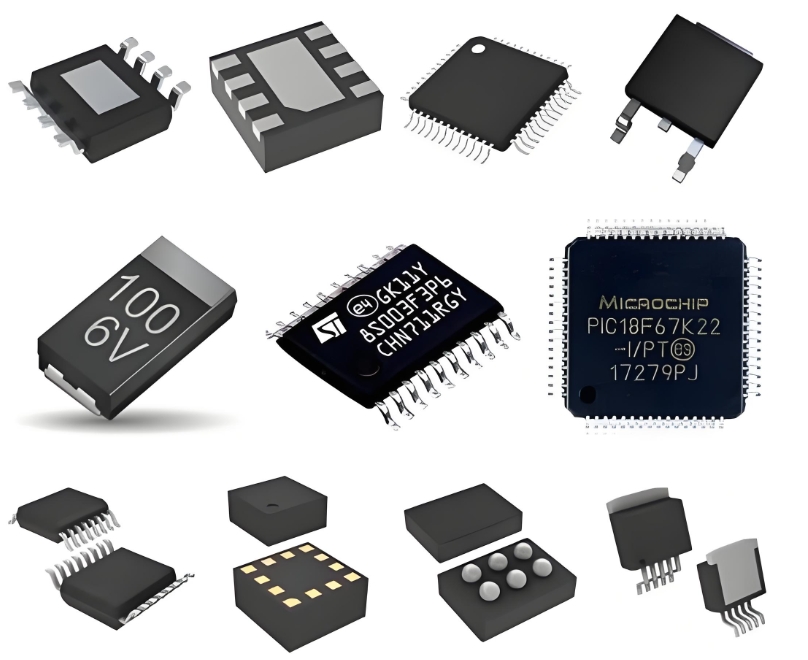
Designing an application circuit with the TC648BEOA is straightforward. The core circuit requires only a few external components for basic operation.
1. Power Supply (VDD): Decouple the supply pin with a standard 0.1 µF ceramic capacitor placed close to the IC.
2. Temperature Sensing: An NTC thermistor (R_NTC) and a fixed bias resistor (R_BIAS) form a voltage divider connected to the VSENSE pin. The ratio of these resistors defines the temperature set-point at which the fan begins to operate and the slope of the speed-versus-temperature response.
3. PWM Fan Drive: The open-drain PWM output pin drives the gate of an external P-channel MOSFET, which in turn switches the power to the fan. A pull-up resistor and a series gate resistor are typically used. A flyback diode is essential across the fan terminals to suppress voltage spikes caused by the inductive load of the fan motor.
4. Tachometer Feedback: The TACH input pin is connected to the open-collector tachometer output of the fan through a pull-up resistor. This provides the feedback necessary for fault detection.
5. Fault Output: The open-drain FAULT pin requires an external pull-up resistor. It remains high-impedance under normal operation and pulls low upon detecting a fan fault.
This simple circuit provides a complete, self-contained, and reliable thermal management solution, making it ideal for applications like power supplies, desktop and server computers, projectors, and industrial equipment.
In summary, the Microchip TC648BEOA stands out as a robust and efficient solution for automated fan control. Its integration of a PWM driver, fault detection, and startup dithering into a single 8-pin package simplifies design, enhances reliability, and optimizes both thermal performance and acoustics. For engineers seeking a high-performance, cost-effective thermal management IC, the TC648BEOA is an excellent choice.
Keywords: PWM Fan Control, Thermal Management, Fault Detection, NTC Thermistor, Application Circuit

